
How to Check Criminal History in West Point
A West Point record check works best when the record type comes first. The West Point Police Department holds reports its officers create. The city clerk handles the formal written request. Cuming E911 is a separate custodian for dispatch audio and computer-aided dispatch data. Filed prosecutions belong to Cuming County Court or District Court. A receiving jail outside Cuming County owns the booking file, and Nebraska State Patrol holds fingerprint-supported statewide RAP history.
- Ask West Point Police for a specific city-created incident or arrest report, using a date, place, and case number when known.
- Submit the city public-record request form to the West Point city clerk when a formal inspection or copy request is needed.
- Check Cuming County Court for misdemeanors, traffic, city ordinances, and early felony events; use District Court for felony trial records.
- For a recent arrest, ask police or the sheriff which Thurston or Madison County facility received the person.
- Use the Nebraska State Patrol RAP search only for the broader Nebraska fingerprint arrest and prosecution layer.
West Point Police Record Request
The city's official public-record request form is the strongest documented path for a West Point police record when no public blotter or report portal exists. It asks for the requester's full name, phone, street and mailing details, a description of the desired record, signature, date, and email or fax. The city then records whether examination was granted or denied and signs the form as a receipt.
Describe the item instead of asking for “all criminal history.” A useful request names an incident report, arrest report, or other city-created file and adds the approximate date, time, location, agency, and report number when known. The form includes an unusual declaration against using the list for commercial solicitation. It cites Nebraska public-record statutes and says most requests receive ordinary handling within four full business days. That is not a fixed delivery promise, and the form publishes no set copy price.
The West Point Police Department
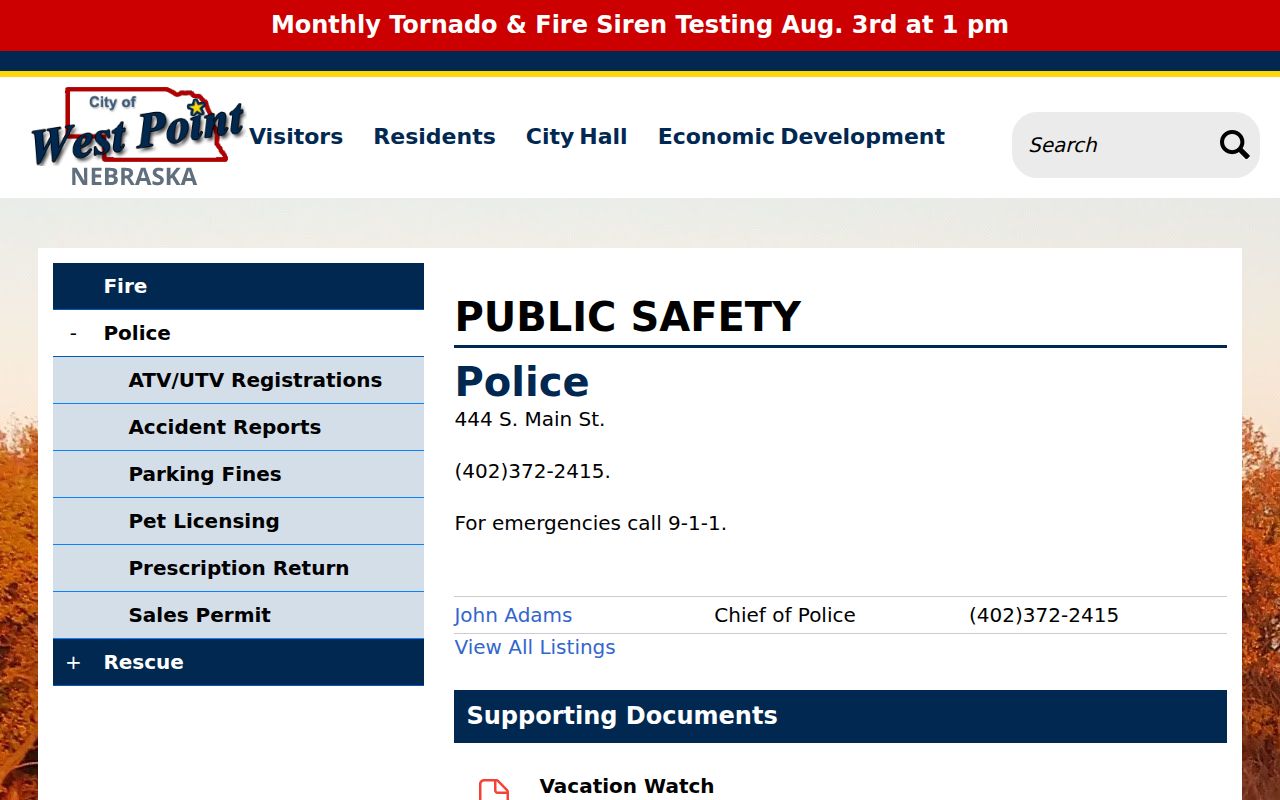
West Point Police operates at 444 S Main Street, West Point, NE 68788, with a published nonemergency number of 402-372-2415. The department is the first stop for a narrative or arrest report created by a city officer. The city clerk is at the same civic address, uses PO Box 327, and can be reached at 402-372-2466 for the formal public-record route.
The official police source also provides a view of the police and city building. The photograph helps distinguish the municipal custodian from the courthouse offices that hold the later case file.
A caller seeking dispatch audio should not assume police holds it. Cuming County E911 dispatches West Point Police and keeps its own CAD and audio records. Its published number is 402-372-6009 and email is E911dispatch@cumingcounty.ne.gov. A single event may require one request to police for the officer narrative and another to E911 for the call trail.
Five West Point Record Custodians
A West Point incident can produce at least five distinct records. Police owns its report. E911 owns dispatch data. A Thurston or Madison County jail may own booking and custody facts. County or District Court owns the prosecution file. Nebraska State Patrol owns any fingerprint-supported RAP entry. These records may share a name and date while answering different questions.
- Police report
- The city officer's allegations, observations, and investigative narrative.
- Dispatch record
- The call, radio, and computer-aided dispatch trail kept by county E911.
- Booking record
- The receiving jail's intake, custody, charge, bond, photo, and fingerprint data as released.
- Court file
- The prosecutor's filed charge, docket, hearings, orders, disposition, and sentence.
- NSP RAP
- Nebraska fingerprint-supported adult arrests and reported outcomes, subject to public limits.
Ask for the product, not merely a “West Point criminal record.” The arrest charge can change when the County Attorney files a complaint. A disposition can take time to reach the state repository. An incident that remains investigative may never become a public court case. The files complement one another, but no one channel replaces all the rest.
Arrests and Bookings in West Point
West Point publishes no official police blotter, booking log, or city inmate roster. That absence reflects local custody, not a broken search page. The official county plan states that Cuming County has no long-term jail and boards prisoners in Thurston or Madison Counties. West Point Police or the Cuming County Sheriff's Office must identify which facility received a particular person. Do not guess between the two counties.
A recent West Point arrest starts with the arresting agency and approximate time and place. Ask where the person was transported. The receiving facility owns the intake and custody record. Once charges are filed, Cuming County criminal court cases provide the complaint, register entries, hearings, orders, and outcome. If a prison sentence follows, switch from the boarding facility to the Nebraska Department of Correctional Services Incarcerated Person Locator.
An arrest is not proof of guilt. The police report states allegations, the jail record reflects custody, and the court file shows whether a prosecutor filed charges and how the case ended. State RAP history is a later fingerprint-based layer. A low-level local event can be absent if it was not fingerprinted or forwarded, so a “No Record” RAP response does not disprove a West Point event documented elsewhere.
No West Point Jail Roster
The safest lookup sequence is to confirm the arresting agency, ask that agency or the sheriff for the boarding destination, and then use the receiving county's official channel. If the arrest happened after hours, E911 answers the sheriff line and may help route the inquiry. Court records can later clarify the filed charge and bond proceeding, but they do not replace the receiving jail's live custody information.
This routing also changes with sentence status. A person serving a Nebraska state prison term belongs in the NDCS Incarcerated Person Locator, not in a Thurston or Madison boarding search. Federal custody is a separate system. The key is to follow the custody stage instead of repeating a search in a West Point roster that does not exist.
West Point Municipal Court Records
West Point has no municipal court. Nebraska does not use a separate municipal-court layer. Under Nebraska Revised Statute §24-517, Cuming County Court has exclusive jurisdiction over city and village ordinance prosecutions and also handles misdemeanors, infractions, traffic, and initial felony proceedings. West Point ordinance or bench-warrant questions therefore go to County Court, not to a nonexistent city docket.
| Correct Court | Cuming County Court, Room 103, 200 S Lincoln Street |
|---|---|
| Case Types | West Point ordinances, misdemeanors, infractions, traffic, and early felony proceedings |
| Lookup Channel | JUSTICE remote search, free courthouse terminal, or County Court clerk |
| What the File Shows | Charges, parties, docket actions, hearings, orders, costs, disposition, and public images |
| Felony Trial | Cuming District Court, Room 200 |
County Court's published number is 402-372-6003. District Court is 402-372-6004. A clerk can help locate a specifically identified file but does not run a broad background check or certify that no record exists. Give the party name, year, case number, and exact document when possible.
West Point JUSTICE Search Limits
JUSTICE is Nebraska's statewide trial-court case service. The remote one-time option currently charges $17 even when there is no result, caps a result at 30 cases, keeps access for three days, and runs with about a one-day entry lag. A free terminal at the Cuming County Courthouse accepts a party name or case number and is often the more controlled route for a known West Point file.
When a party search returns more than 30 results, refine the criteria rather than buying the same broad search again. Check spelling, aliases, filing lag, whether the matter stayed an agency investigation, and whether juvenile or confidential rules apply. A missing result is not proof that no city report exists. JUSTICE searches filed court matters, not the West Point Police narrative or Cuming E911 call record.
Case details may show the summary, outcome, judge, parties, attorneys, offense, assessed and paid costs, register of actions, judge notes, and nonconfidential images filed or uploaded after the system's image date. The party search is not a witness search, and it is not real-time warrant confirmation.
Where West Point Records End Up
A city event moves through systems only when the next custodian has a reason to act. Police writes the report. The receiving jail makes the booking file. The County Attorney decides what to charge. County Court opens the first criminal docket, and a felony trial proceeds in District Court. A fingerprint card may create the statewide event, while the court outcome should later be matched to that cycle.
Record flow: West Point Police › Cuming County Courts › Nebraska State Patrol Criminal Identification Division
This line describes the prosecution path, but it does not erase side records. E911 remains the custodian of dispatch material. The receiving jail remains the custodian of booking details. Missing prints, a card that was not forwarded, a name mismatch, or reporting lag can leave a gap in RAP history. Searchers should compare the West Point report, court file, and state result instead of treating any one as complete.
Three West Point Court Record Counters
West Point is Cuming County's seat, so three major criminal-record counters sit inside the courthouse at 200 S Lincoln Street. County Court is in Room 103. District Court is in Room 200. The Cuming County Sheriff is in Room 203. The building is generally open Monday through Friday from 8:30 a.m. to 4:30 p.m., but each office controls only its own files.
Cuming County Court
Room 103
Misdemeanors, traffic, ordinances, initial felonies
402-372-6003
Cuming District Court
Room 200
Felony trials and older District records
402-372-6004
Cuming County Sheriff
Room 203
Sheriff records and boarding-facility routing
402-372-6019
Physical closeness can save travel, but it does not merge custody. A city police report still begins at 444 S Main. District Court records reach into the 1800s and can support old case or family-history research. The clerk can direct a visitor based on workload. District copies cost $0.25 per page and certification costs $1 per seal or document; mailed work needs prepayment and a self-addressed stamped envelope.
West Point Records Since 1955
The present courthouse explains why West Point is both a city-record starting point and a county justice hub. Voters approved a courthouse levy in 1947. Ground was broken in 1953 behind the old courthouse. Offices moved during 1954, and the current courthouse was dedicated in 1955. Courts, the sheriff, and E911 now share that county building, while West Point Police and the city clerk remain at the municipal address.
That history helps with modern routing. A city officer's narrative stays with city government even though the later court and sheriff channels are nearby. The city's name itself reflected its place as the westernmost settlement of its era. Today, its county-seat role gives searchers access to city, court, sheriff, and state routes without changing which office legally maintains each West Point criminal record.
Public Access Rules
West Point Police and the city clerk answer record requests under Nebraska Public Records Law. A custodian generally must provide access, deny the request, give a cost estimate, or explain the delay and earliest practical date within four business days. That clock is not a promise that every record will be produced in four days. Redaction, a pending case, protected victims, juvenile material, security issues, or a request spread across custodians can take longer.
Key Statutes:
Nebraska Revised Statute §84-712 allows inspection and copies during business hours and sets the response, estimate, and deposit framework.
Nebraska Revised Statute §84-712.05 lists exemptions that can protect investigations, security data, personal information, and victims.
Nebraska Revised Statute §29-3506 defines criminal-history information and separates it from intelligence and investigative material.
Nebraska Revised Statute §24-517 places West Point ordinance prosecutions in Cuming County Court.
A focused description helps the custodian apply those rules. State the file type, approximate date, location, involved agency, case number, desired format, and delivery method. A denial may be taken to the Nebraska Attorney General without charge or challenged in court. A requester should not treat lawful redaction as proof that no West Point record exists.