
Criminal Cases in the Cuming County Courts
Cuming County divides criminal case records by jurisdiction. Cuming County Court hears misdemeanors, infractions, traffic matters, juvenile petitions, city or village ordinance cases, and the first stages of a felony. A felony trial belongs in Cuming District Court, part of Nebraska's Seventh Judicial District. District judges serving that district include Michael L. Long and Ryan J. Stover. Nebraska has no municipal-court layer here. A West Point, Wisner, Beemer, or Bancroft ordinance prosecution therefore belongs in County Court, not in a separate city docket.
The clerk for each court is the custodian of its own case file. County Court is in Room 103 of the Cuming County Courthouse and can be reached at 402-372-6003. District Court is in Room 200 and can be reached at 402-372-6004. The official County Court page shows the local counter and its case types.
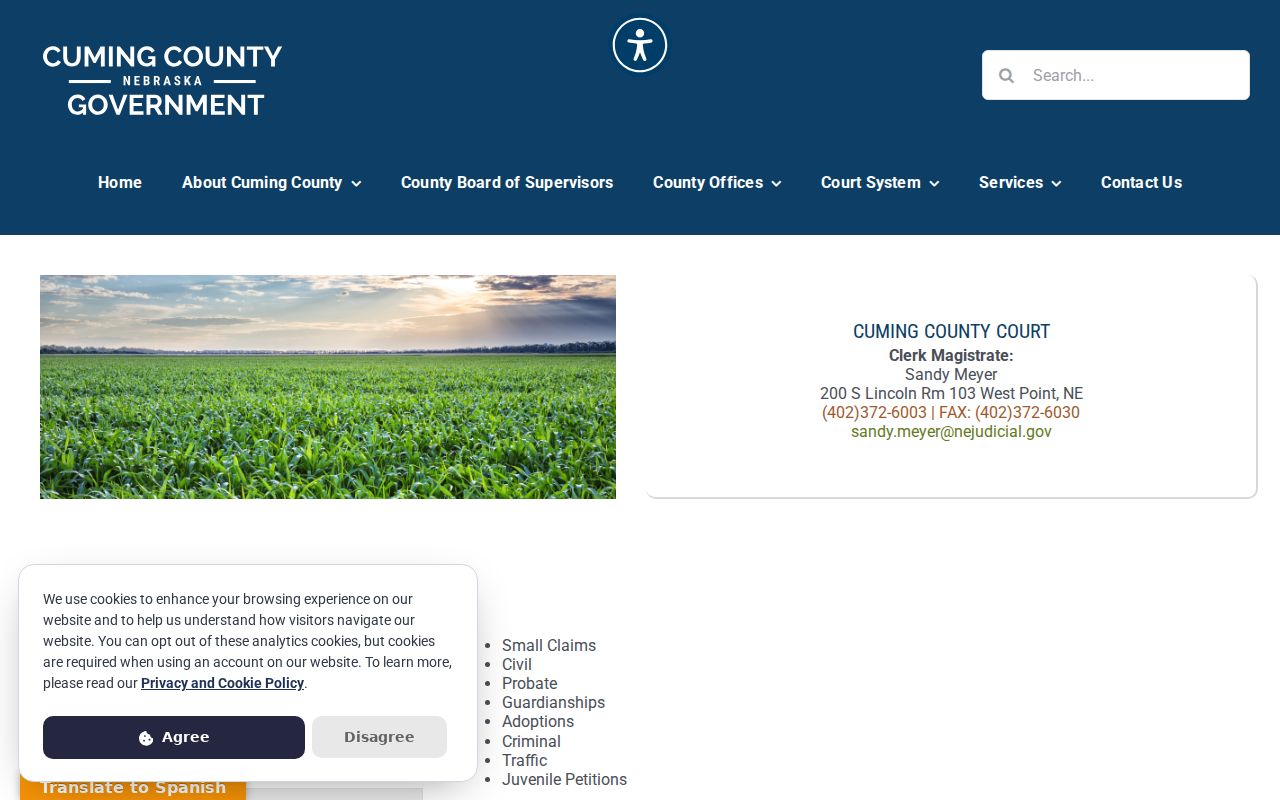
That local page helps a reader choose the right clerk before asking for a complaint, register entry, order, judgment, or certified copy.
Cuming County Case Court Routes
The two-room route prevents a common Cuming County search error. County Court can hold the complaint, bond proceedings, preliminary hearing, and early orders in a felony matter. After the probable-cause stage, the felony trial record moves to District Court. A misdemeanor tied to the same incident as a felony may also be heard in District Court. For an ordinance matter or stand-alone misdemeanor, County Court remains the place to ask.
| Case level | Cuming County court | Typical record |
|---|---|---|
| Ordinance, infraction, traffic | County Court | Complaint, register, disposition |
| Misdemeanor | County Court | Plea, motions, judgment, sentence |
| Initial felony matter | County Court | Complaint, bond, preliminary proceedings |
| Felony trial | District Court | Information, trial filings, judgment, sentence |
A case number is the best bridge between systems. If only a party name is known, ask which court and case type the result identifies before ordering a document.
How to Search Case Records
The Nebraska Judicial Branch describes JUSTICE as the statewide trial-court case-information service. Remote one-time access costs $17 under the live terms inspected in July 2026, even when no case is found. It caps results at 30 and keeps access for three days. Cuming County entries can lag by about 24 hours. A free public terminal at the courthouse accepts a party name or case number, while a clerk can locate a specifically identified file.
- Choose the free courthouse terminal or accept the paid JUSTICE one-time search terms for remote access.
- Start with the party name. A witness name is not a party search, and an exact case number should use the case-number route.
- If the result exceeds 30 cases, narrow by Cuming County, court type, case type, subtype, year, judge, or attorney as the available screen permits.
- Open the summary and register of actions, then inspect the offense data, outcome, financial entries, notes, and available public images.
- Call the correct clerk with the case number and exact document name when a plain, certified, mailed, or older copy is needed.
| Search field | Type | Required | Use |
|---|---|---|---|
| Party | Name | Primary route | Find a defendant listed as a case party |
| Court type | Filter | No | Separate County from District Court |
| Case type or subtype | Filter | No | Narrow a broad party result |
| County and year | Filter | No | Limit results to Cuming County and a filing period |
| Judge or attorney | Filter | No | Subscriber criteria that can refine a match |
| Case number | Direct search | No | Open a known case without a broad name search |
Cuming County JUSTICE Case Limits
JUSTICE is convenient, but its limits shape the search. Cookies and JavaScript must work. A broad query that returns more than 30 results must be refined. The live charge is due even for no result, so check spelling, aliases, court level, and likely filing year before paying again. The service emails search criteria and an identifier, and access lasts three days. Nonconfidential images filed or uploaded after April 16, 2008 can appear with the detail.
A miss does not prove that no Cuming County case exists. Entry lag, a spelling difference, a sealed or juvenile matter, older paper material, or the wrong court may explain it. The Nebraska Court Records Search Policy allows public terminal searches and clerk help with a named case, but it does not require staff to conduct a broad background search or certify that no record exists.
Note: Search broadly once, then refine a result set instead of buying repeated searches that use slightly different spellings.
What the Case File Shows
A court file documents litigation, not just the event that led to an arrest. Nebraska court-record rules call for a register, trial docket, judge notes, financial record, indexes, and the case file itself. In Cuming County, a useful review starts with the charging document and register of actions, then moves to the disposition and sentence. Public images can supply the actual text of a motion or order when a short docket label is not enough.
| Case number and court | Identifies the file and whether County or District Court holds it. |
|---|---|
| Complaint or information | States the charge filed by the prosecutor; an information is a prosecutor's charging instrument. |
| Parties and attorneys | Names the defendant, state, and counsel shown in the public case. |
| Register of actions | Lists filings, hearings, orders, and other events in date order. |
| Offense and outcome | Shows criminal-offense data, plea or trial result, dismissal, acquittal, or conviction. |
| Money entries | Shows assessed or paid costs, restitution, or judgments when public. |
| Judgment and sentence | Records the court's final order, sentence, and public conditions. |
The register is a chronology, while a filed image is the document itself. Read both when a short entry such as “motion granted” does not reveal the scope of the order.
Cuming County Court Copy Options
District Court records reach into the 1800s. For older Cuming County criminal cases, visit or call the District Court counter with a year, case type, party name, and case number if known. Staff can direct a researcher, though help depends on workload. District copies cost $0.25 per page, and certification costs $1 per seal or document. A mailed request needs prepayment and a self-addressed stamped envelope. Fax delivery costs $2 for the first page and $1 for each added page. The District Court does not accept cards for these services.
The official Cuming District Court page shows the records counter and terminal.
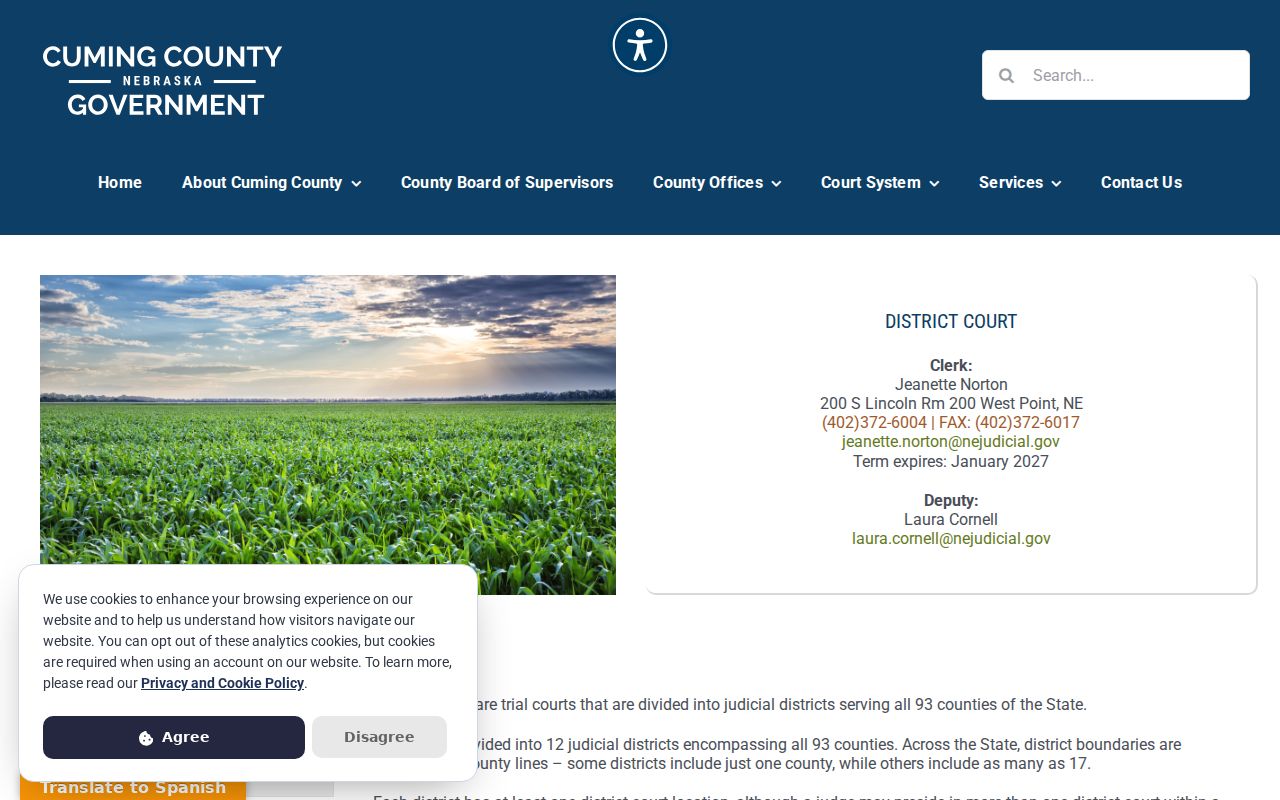
The image reinforces why remote search and clerk copies are separate channels: the portal finds public case detail, while the clerk supplies a named paper or certified record.
Stages of a Criminal Case
A Cuming County prosecution begins when the Cuming County Attorney files the charge. County Court handles arraignment and preliminary felony matters as its jurisdiction permits. The case then moves through pretrial motions and discovery. A plea can end the fact-finding stage, or a trial can lead to a verdict. The disposition states how the charge ended, and a conviction leads to sentencing. Felony trial proceedings belong in District Court, while most misdemeanors stay in County Court.
Case flow: Charges Filed › Arraignment › Pretrial › Plea or Trial › Disposition › Sentencing
The filed charge can differ from the arrest allegation. For that reason, a reader tracing the outcome should use the court complaint or information and final judgment, not rely on an arrest label.
Cuming County Criminal Motion Day
Cuming District Court publishes a local criminal motion schedule: the first Thursday of each month at 9:00 a.m. A motion day is not a promise that every case will be heard or that a specific hearing remains set. Use the register of actions and confirm with the clerk. This local schedule is most useful after a case number has been found and the docket shows a motion or hearing notice.
Motion practice can affect bond, evidence, scheduling, plea discussions, or other case issues. The public file may show the motion, a hearing entry, the judge's order, and later changes. If only the docket label is visible online, ask the clerk whether the underlying public image or a copy is available. This is a more reliable way to understand a Cuming County case than guessing from a calendar entry alone.
Older Cuming County Case Records
Pre-digital Cuming County criminal records require a different search habit. District Court's on-site books reach the 1800s, well before modern JUSTICE coverage. Start with the closest known year, the name used at the time, and the kind of proceeding. A clerk may point to an index or book, but the office does not promise unlimited genealogy or open-ended background research. Specific requests receive the clearest route.
Old entries can use terms that need context. “Disposition” means the outcome. “Nolle prosequi” means the prosecutor abandoned a charge. “Recognizance” is release based on a promise rather than posted cash. “Concurrent” sentences run together, while “consecutive” sentences run one after another. A set-aside nullifies an eligible conviction under Nebraska law but remains visible with a notation. It is not erasure.
Federal Cuming Criminal Case Records
A federal prosecution involving Cuming County does not live in the county courthouse file. Cuming lies in the U.S. District Court for the District of Nebraska. PACER is the official remote federal case-access channel. Registration is free; current access is generally $0.10 per page, usually capped at $3 for a case-specific document or report, with a quarterly fee waiver when the total is $30 or less. Federal courthouse terminals and opinions are free.
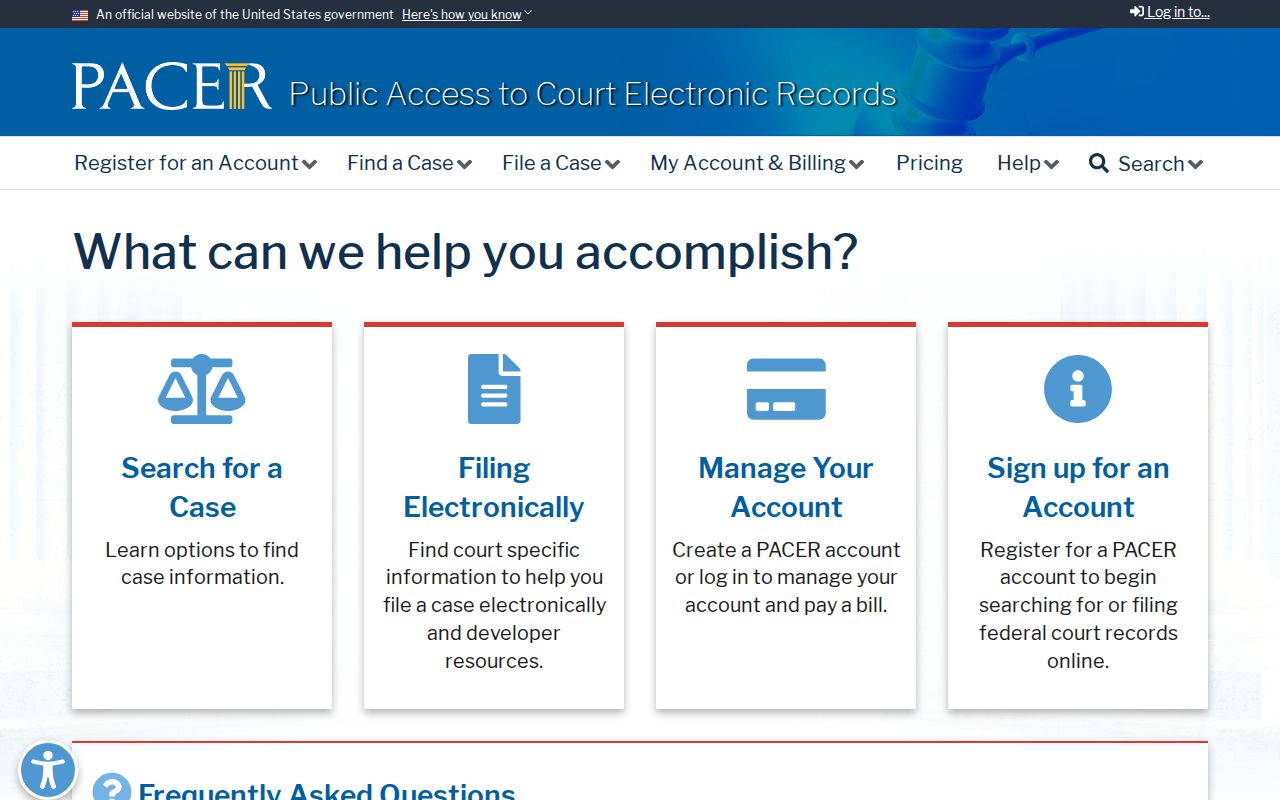
The PACER screen marks a clear boundary: county and state prosecutions use Cuming County clerks and JUSTICE, while federal filings use the federal docket.
Access & Restrictions
Nebraska law favors public access, but not every Cuming County court record is open in full. Juvenile matters, sealed adult records, protected victim information, and other confidential material can be absent or redacted. Under Neb. Rev. Stat. §84-712.05, listed exemptions can protect investigative, security, personal, and victim-sensitive information. A public online view may also contain less than the paper file.
If a known Cuming County case does not appear, check the spelling, court level, filing date, and case number. Then call the correct clerk. Ask whether the matter is too new for the remote index, held in an older medium, sealed, juvenile, or otherwise restricted. A court record should also be distinguished from the statewide NSP RAP. The court file gives the charging and litigation history, while a RAP depends on a fingerprint-supported arrest cycle and reported disposition. Broader county criminal-history routes are summarized on the Cuming County criminal history overview.
Note: A portal miss is a reason to verify with the clerk, not proof that no Cuming County case exists.